Thuja e-bike by vanRaam tested by E-Bike Magazine
E-Bike Magazine conducted an extensive test of the latest Thuja e-bike. Curious about their experiences and verdict on this electric bike? Watch the video and read more in this article.
News
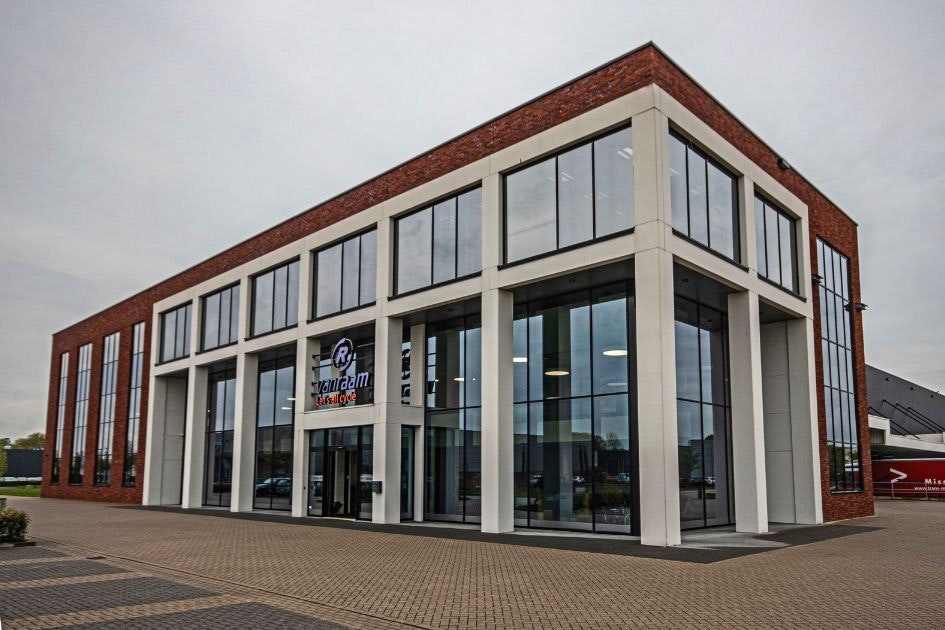
Innovation driver, high-tech adopter, global market leader. vanRaam, the specialist bicycle manufacturer, brings all of this together. A visit to the company’s headquarters in Varsseveld in the Netherlands reveals a business driven by energy and ambition.
This interview was originally published in the trade magazine Velobiz. With kind permission, we now present the full article on our website.
Text and photos: Georg Bleicher
Jan Willem Boezel, one of the CEOs and Technical Director at vanRaam, sums up the company’s development in a single sentence: “Strictly speaking, we are not bicycle manufacturers. We have been mechatronics engineers for a long time.” A tour through the production halls in Varsseveld quickly shows what he means. High-tech solutions are everywhere, integrated into the bikes themselves as well as into the manufacturing processes.
The story begins in Amsterdam. In 1900, company founder Henk vanRaam opened a metal workshop that soon specialised in bicycle frames, following the cycling boom at the turn of the century. Business grew rapidly and remained successful for decades. As more and more German manufacturers began purchasing the robust steel frames, the company moved closer to the German border in the 1970s, settling in the town of Varsseveld. The proximity of steel suppliers played an important role in this decision.
When low-cost frame production in Asia became standard in the 1970s and 1980s, vanRaam, then employing 25 people, struggled to compete. In 1984 the company effectively went bankrupt, as Director of Business Development Marnix Kwant explains. Entrepreneur Piet Boezel acquired the business, and a chance event soon set its future direction. An acquaintance of the owner had suffered an accident and could no longer ride a standard two-wheeled bike. In 1986, vanRaam built its first tricycle, shaping the path the company would follow from then on.
From 1992 onwards, the company produced only its own bikes. What began out of necessity with tandems and side-by-side tandems developed steadily from the mid-1990s onwards. vanRaam had found its niche, and that niche continued to grow.
Today, the range extends from fully customised rehabilitation bikes down to the smallest detail, to visually appealing tricycles with a strong lifestyle character. In the two-wheeled category, the Balance low-step bike remains a key model, featuring a saddle height that allows riders to reach the ground easily with both feet while seated.
The portfolio also includes tandems with steering from either the front or rear seat, side-by-side tandems, bikes designed to transport adults, models that can fully accommodate a wheelchair, and half-bikes that only become a vehicle when combined with a wheelchair. It is a broad and carefully developed range within the specialist bike segment.
“Every single bike we sell is customised,” says Kwant. Production only begins once a customer places an order through a specialist retailer. Customisation starts with the choice of colour and continues through to specialised components such as shortened cranks or leg supports. This level of individualisation requires in-depth consultation. “We currently have 196 dealers in Germany, and we are working hard to expand that number. Retailers can order models they do not have in stock for short-term customer test rides.”
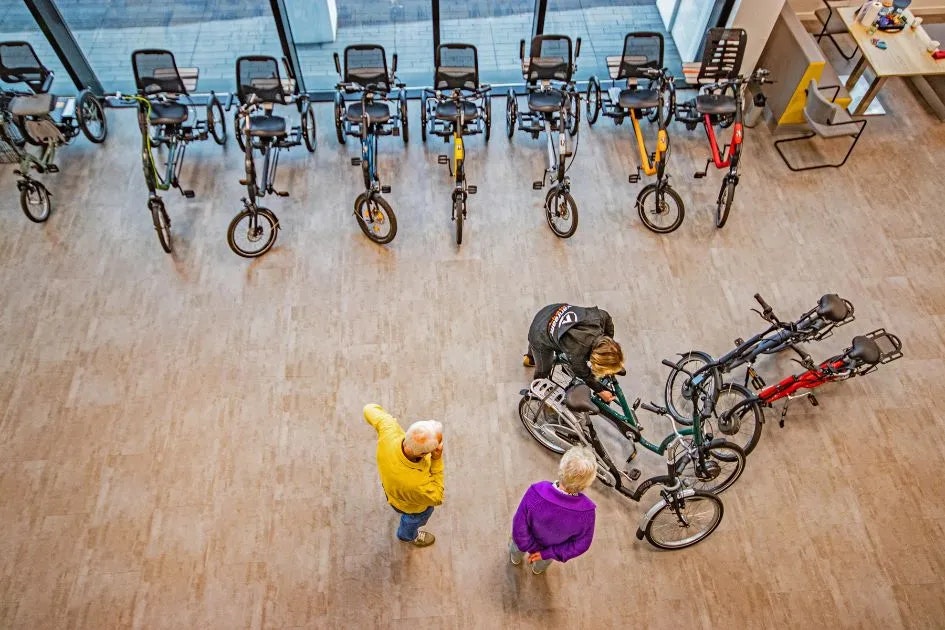
In the showroom, which spans the full width of the light-filled office building in Varsseveld, activity is constant. “We have around 50 bikes ready to ride, and people come from all over to test them,” says Kwant. Test rides take place on a specially designed track next to the production halls, featuring rough surfaces, gravel and cobblestones.
Purchases are always made through specialist retailers, and every bike is built only after an order is placed. This model proved particularly valuable in recent years. “Many dealers tell us that specialist bikes saved their business after the pandemic,” Kwant notes with pride. Unlike standard bikes, vanRaam models require no storage space at the retailer.
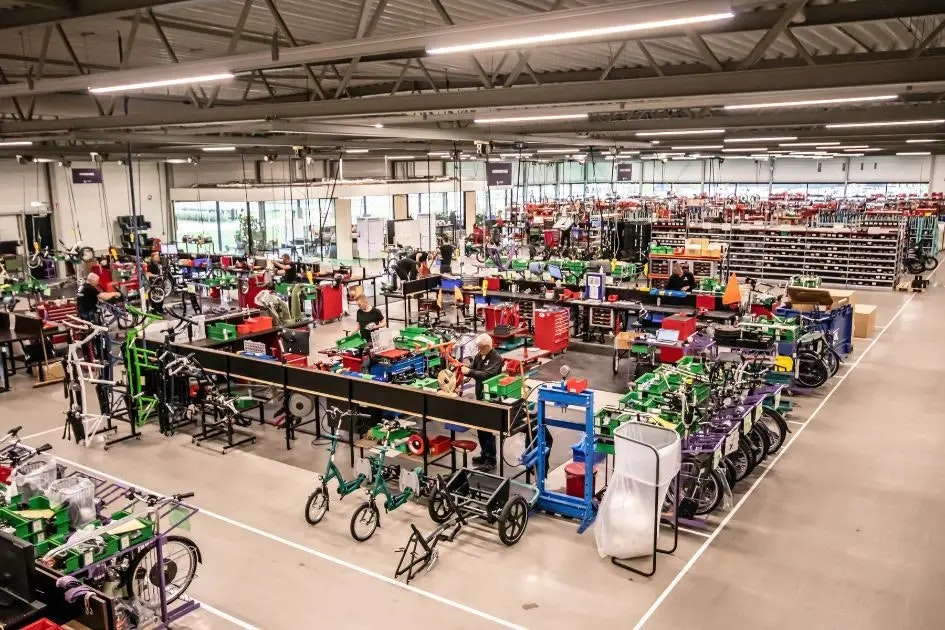
Bikes are assembled on four production lines in Varsseveld. In 2020, identical lines were installed in a dedicated facility in Poland, after it became clear that the surge in demand during the pandemic could not be met without expansion.
Completing a Fun2Go, a highly complex electric side-by-side tandem, takes about one day. Five to six frames move sequentially along the line. Assemblers select components from a trolley equipped with all parts needed for that specific bike. These trolleys are stocked semi-automatically. In the previous picking station, shelving units up to six metres long are lowered from high-bay storage to working height.
Screens at each station indicate exactly which compartment holds the required component. Once a part is picked and confirmed in the system, inventory levels are updated automatically and purchasing is notified when reordering or in-house production is required. Manufacturing many components internally is a key factor in the company’s success, and vanRaam takes pride in the intelligence and modernity of its facilities.
Equally state-of-the-art is the Your CNC Solutions department, located in a large adjacent hall. Department head Dominic Tempels stands beside massive, fully automated turning and milling machines. “Around 50 percent of what we produce here is for vanRaam,” he explains. “The rest is for a range of external clients.”
At the moment, a special axle around 40 centimetres long for a tandem bike is being machined. The process takes just five minutes. “Programming is done by computer specialists,” says Tempels. “It’s complex work where precision matters enormously.” Pedals, footrests, axles and many other components are produced here, alongside very different items such as an 80-centimetre onion slicing blade for a commercial kitchen.
Quality control is performed using laser measurement, accurate down to micrometre levels. The first, fifth and last part of each production run are checked to ensure exact dimensions.
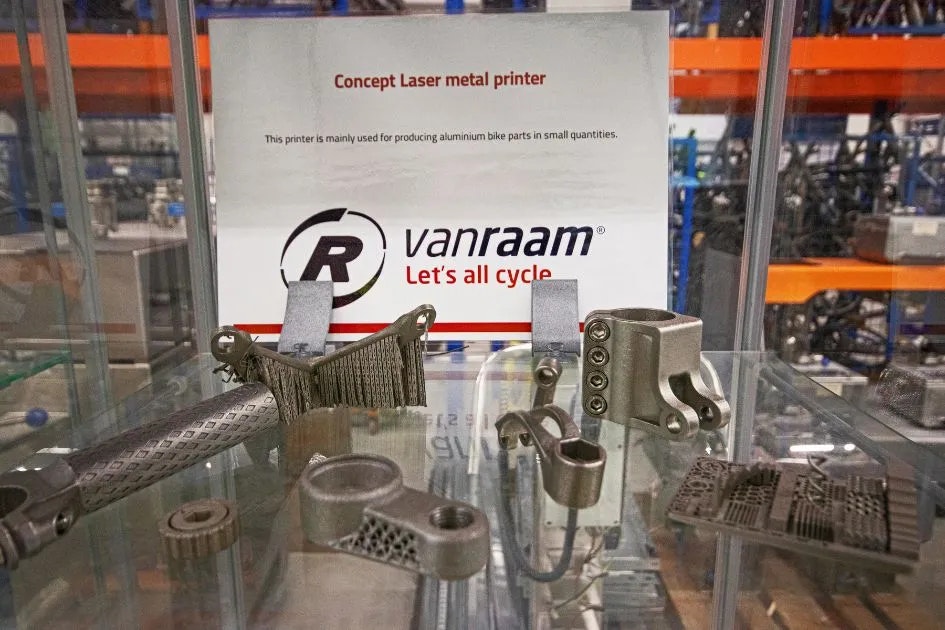
Three 3D printers are now standard equipment at vanRaam. “They were a huge help during the pandemic,” says Kwant. “When certain standard parts could not be delivered, we simply printed them ourselves.” A single missing component can otherwise halt an entire production line.
The department’s display cabinet shows what can be printed in plastic and metal. Cranks, stems, tools and even unrelated products are on display. Remarkably, multi-part plastic items such as gripping aids can be printed fully assembled and ready for use in a single process.
vanRaam frames are made from steel. “For our purposes, it offers the best overall properties,” explains Kwant. “It is easy to shape and process.” Specialist bikes do not need to be ultra-lightweight. Robustness is far more important.
The hydroformed tubes used in newer Easy Rider models also add a subtle lifestyle aesthetic thanks to their design freedom, combined with unlimited colour choice. The visual impact of some exclusive colours is clearly visible in the showroom.
Frame tubes are cut and processed by fully automated laser cutting machines. “They work with a level of precision and speed that humans simply cannot achieve,” says Kwant. “They also reduce staffing needs by 80 percent.” The laser cutter in question is only two years old, the size of a family house and operates fully automatically. In seconds, it cuts shapes and drill holes into the main tube of a Twinny Plus frame.
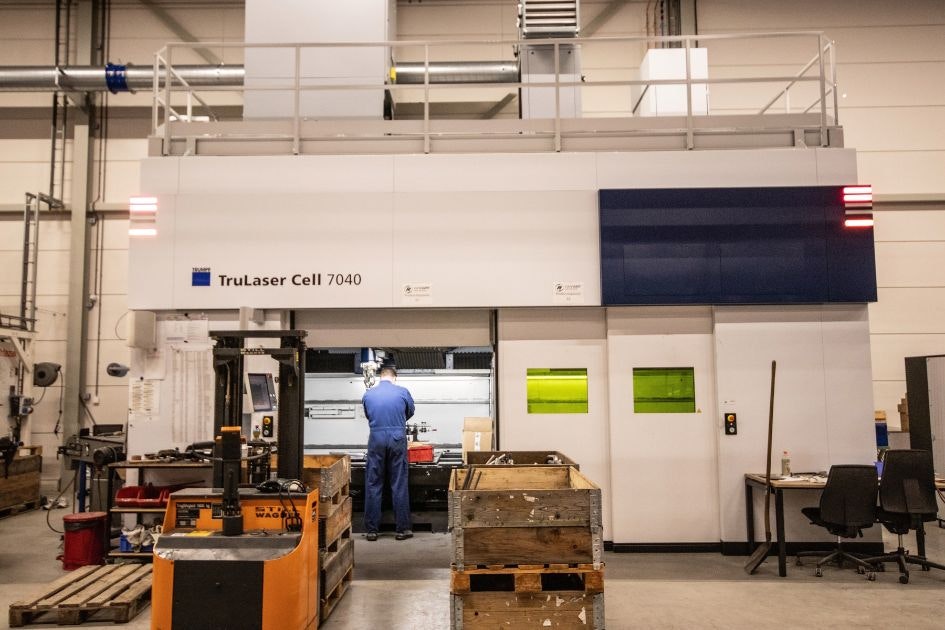
A walk through the production facilities makes it clear that vanRaam is geared for growth. In 2023, this ambition was underlined by the majority investment of Munich-based holding company Armira, laying the foundation for further expansion in the years ahead.
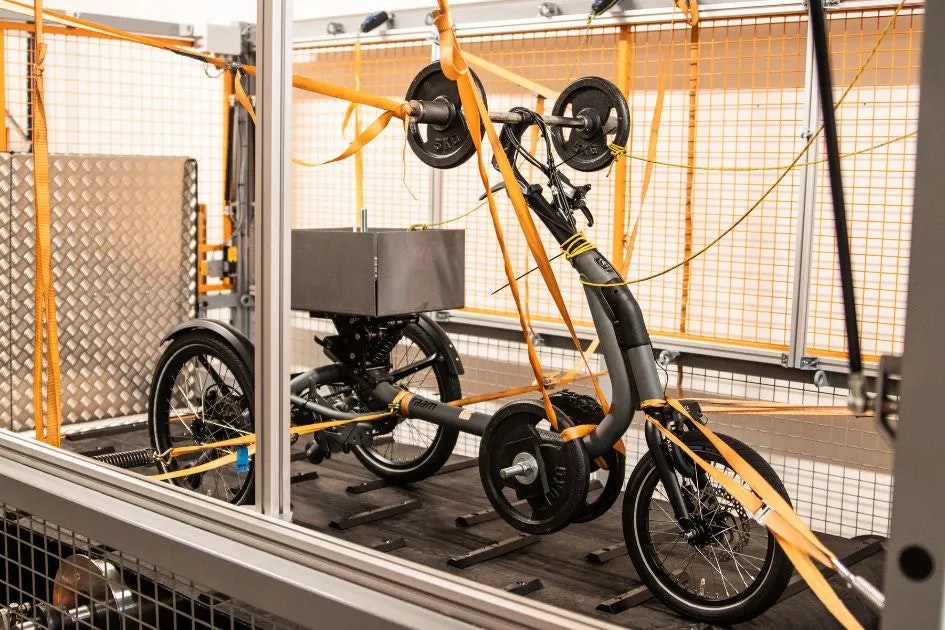
Engineers and buyers work in glass-enclosed offices located directly within the production hall. “That way, they are right where they are needed,” explains Kwant. Nearby is an in-house TÜV test rig, currently testing an Easy Rider model. “A single external test costs us 28,000 euros,” says Kwant. “To avoid having to repeat tests because of minor issues, we built an identical test rig ourselves.”
New models are thoroughly tested internally before being submitted for official certification, allowing any issues to be resolved in advance.
Jan Willem Boezel has much more to say about vanRaam’s future ambitions. “Ultimately, we want to build the most comfortable bicycle imaginable,” he says, before presenting an impressive prototype. It resembles an armchair on wheels, featuring a self-developed front swingarm instead of a traditional suspension fork. At the rear, two sharply angled suspension struts support independently mounted wheels.
The first riding impression says it all: “Have I already passed the cobblestones?” The ride feels smooth and effortless, more like gliding in a luxury car than cycling.
Founded: 1900
Headquarters: Varsseveld, Netherlands
Production area: 18,000 m², plus 13,000 m² in Poland
Products: two-wheel bikes, tricycles, tandems, side-by-side tandems, scooter tricycles, e-bikes with throttle, wheelchair bikes, transport bikes
Employees: 330
Annual production: 18,000 bicycles
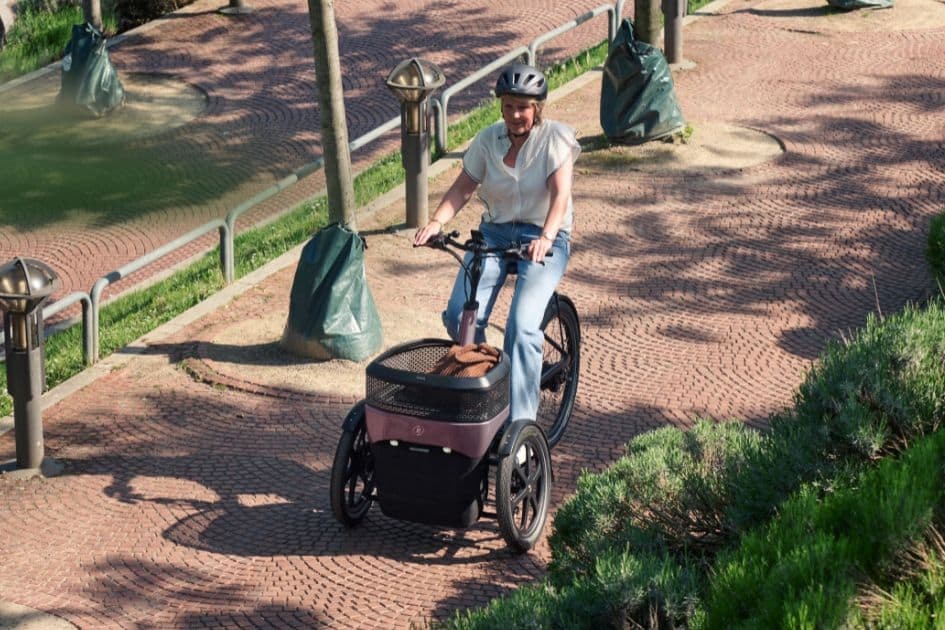
Whether and when the armchair bike will go into series production remains unclear. What is already available, however, is another major development: the Thuja. It features two independently steered 20-inch front wheels, a stylish integrated basket between them, and a single 28-inch rear wheel. From the side, it almost resembles a low-step two-wheeler. That is exactly the point. With the Thuja, vanRaam aims to remove the rehabilitation stigma often associated with tricycles.
The bike truly feels like a new category. It offers exceptional riding stability for everyday use, errands and even weekly grocery shopping. The battery is located beneath the lockable basket, ensuring a low centre of gravity and secure storage space.
At Eurobike 2025, the Thuja received an award immediately, followed by the prize for Best Product Development Team at the Paris ProDays 2025.
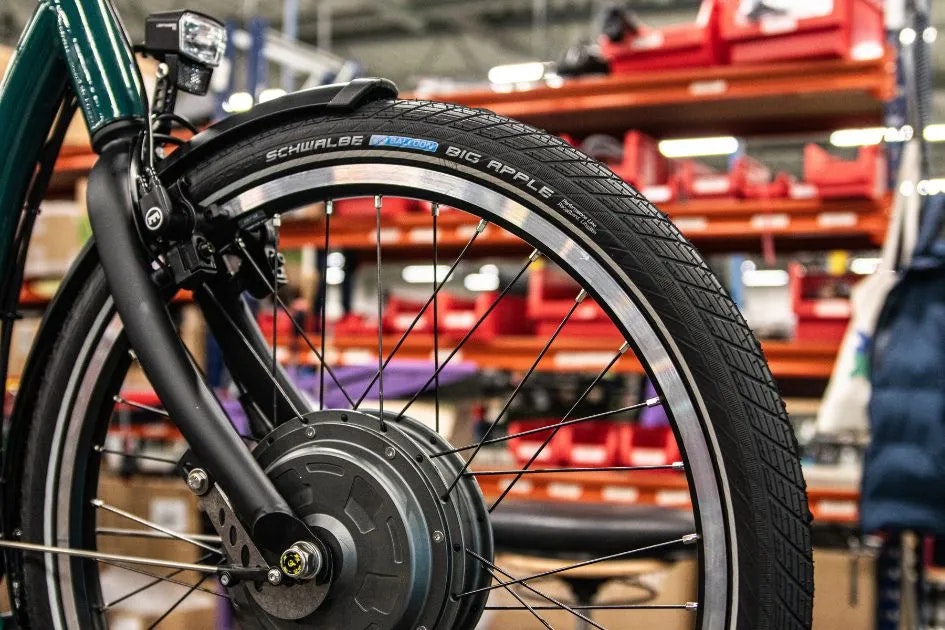
Most vanRaam bikes are sold with a motor as standard. “Specialist bikes such as side-by-side tandems need features like reverse gear,” explains Boezel. For years, the company has used its own motor system with front or rear wheel drive, combined with in-house developed software. Batteries are supplied by BMZ.
Looking further ahead, vanRaam has developed a fully chainless system in collaboration with a project group from Bochum University. Equipped with two generators, the system delivers a riding feel closer to traditional chain drives than previous concepts, while reducing weight and offering greater design freedom. Riders pedal into individual generators, which supply power to the rear wheels via advanced software. The result is always the right perceived gear, without shifting. Comfort, once again, is the goal.
As a manufacturer of medical devices, including rehabilitation bikes, vanRaam must comply with additional standards. This includes the annual publication of a Post Market Surveillance report covering systematically collected safety and performance data. The company emphasises that it exceeds all required standards.
“Sustainability is an incredibly broad topic for us,” explains QHSE Manager Walter Smit. CO₂ footprint and circular economy principles are monitored throughout the supply chain, supported by extensive data beyond legal requirements. “We make our sustainability measurable, well beyond what is required,” says Smit.
In 2024, vanRaam conducted a Life Cycle Analysis covering its three best-selling models and documenting the CO₂ footprint of all components. The lifespan of bikes, along with feedback from users and retailers, is tracked over time. Environmental commitment is also visible on-site. The main building is powered by nearly 2,000 solar panels, circular production processes are fully implemented, and a new paint facility reduces gas consumption by 30 percent compared to the previous one.
Finally, as a company serving many people with disabilities, vanRaam embraces a strong sense of social responsibility. According to Smit, significantly more people with disabilities are employed than legally required. They also transition earlier from government-supported employment into direct contracts with the company. This aligns perfectly with vanRaam’s guiding principle: cycling for everyone.
Across the organisation, employees clearly share this passion, each contributing in their own way to a vision that feels both genuine and deeply rooted.

E-Bike Magazine conducted an extensive test of the latest Thuja e-bike. Curious about their experiences and verdict on this electric bike? Watch the video and read more in this article.
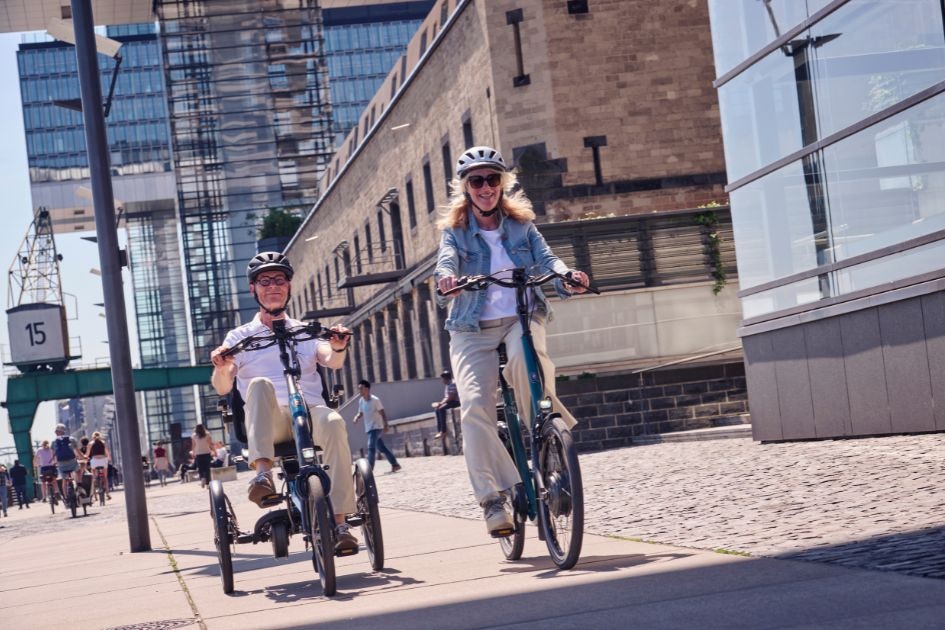
Do you doubt your balance on a bike? Do e-bikes, cargo bikes, and scooters around you make you feel insecure? Or do you react a little slower than you used to? With vanRaam’s models, cycling is always possible, because we focus on what is possible. This constantly leads to new ideas. Jolien Heeman, Director of Product Management: “If it hasn’t been invented yet, we’ll invent it ourselves.”
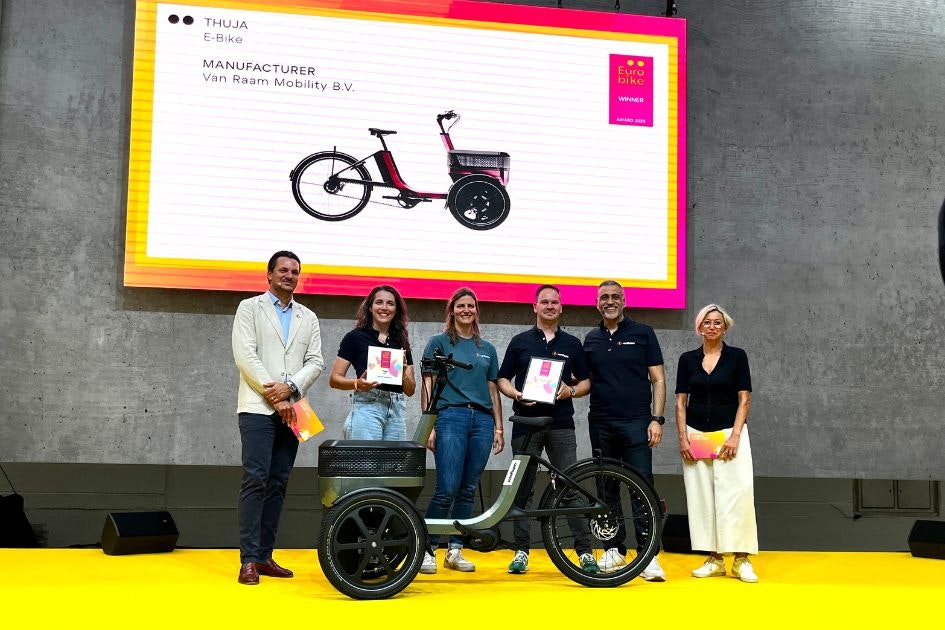
Our latest innovation, the Thuja, has been awarded the prestigious EuroBike Award 2025. The Thuja is a stable, stylish e-bike designed especially for active seniors. The Thuja combines the agility of a city bike with the comfort and stability of a tricycle.
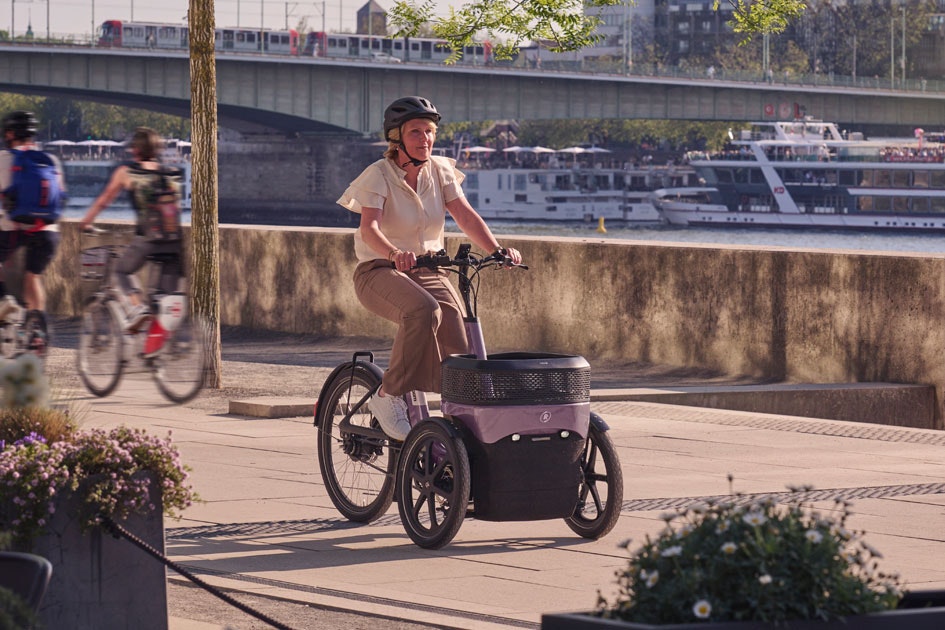
'Due to demographic developments and the increasing interest of older people in health and an active lifestyle, this bicycle category has significant and sustainable growth potential.' Gerwin Sieders, Chief Commercial Officer at vanRaam, discusses the opportunities and challenges in the special needs bicycle market in an interview.
We are happy to assist you! Please check our contact page or contact us directly using the options below.
Menu
Search
Our bikes